
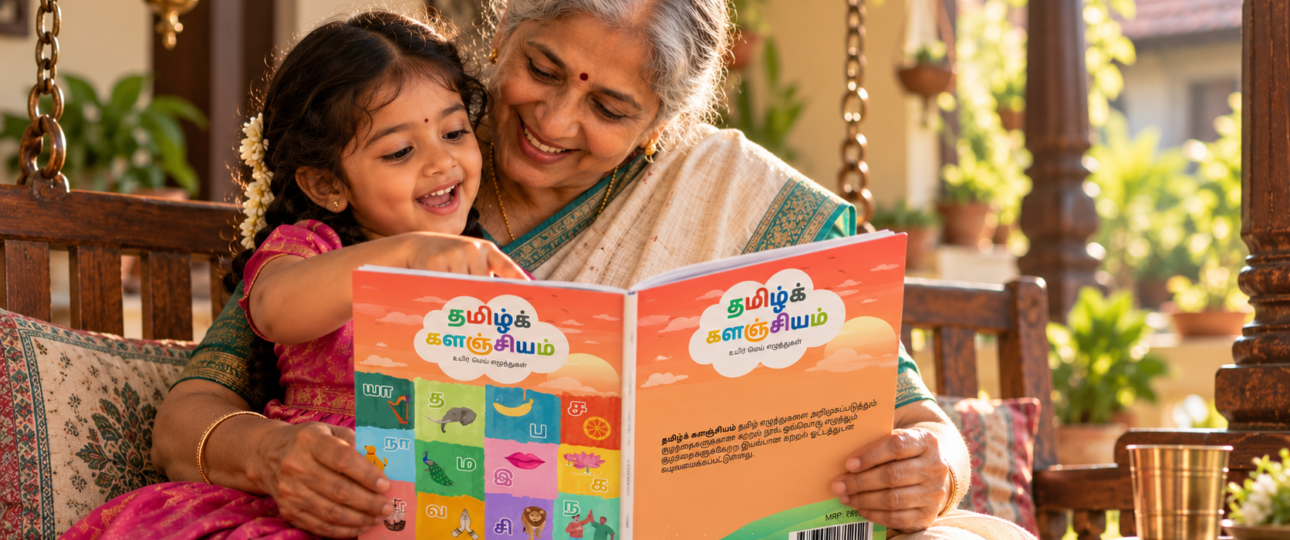
There’s a common worry among parents: “Will teaching my child two languages at once confuse them?” The research says the opposite — bilingual children often show stronger problem-solving skills, better focus, and more flexible thinking than monolingual peers, because their brains are constantly practicing switching between two systems.
Why early is easier
Children under 6 acquire language almost effortlessly, absorbing sounds, grammar, and vocabulary the way they absorb everything else — through repeated, playful exposure. This is why introducing Tamil alongside English early on (rather than waiting) tends to produce far more natural fluency in both.
How books make bilingual learning natural, not forced
Books like Uyir Tamil and Tamil Kalanjiyam don’t try to “teach grammar” — they immerse a child in Tamil letters and words the same playful way an English alphabet book would, through color, rhythm, and story. That’s the key: bilingual learning sticks best when it feels like play, not translation homework.
Tips for parents raising bilingual readers
- Read one language at story time and the other at another time of day — consistency helps kids compartmentalize naturally
- Don’t correct language-mixing too early; it’s a normal part of bilingual development, not a sign of confusion
- Celebrate small wins — a child pointing at “ஆ” and saying “apple” in English is proof both languages are taking root together
The long-term payoff
Beyond the cognitive benefits, a bilingual child carries a piece of cultural identity and connection to family that a monolingual upbringing can’t fully replicate. Every book you read together in Tamil is doing double duty — building language skills and building belonging.